Looking for a SPAC Tracker?
Meshflow is the most advanced real-time tracker for Special Purpose Acquisition Companies (SPACs). Access authoritative data on trust proceeds, warrants, and deal velocity.
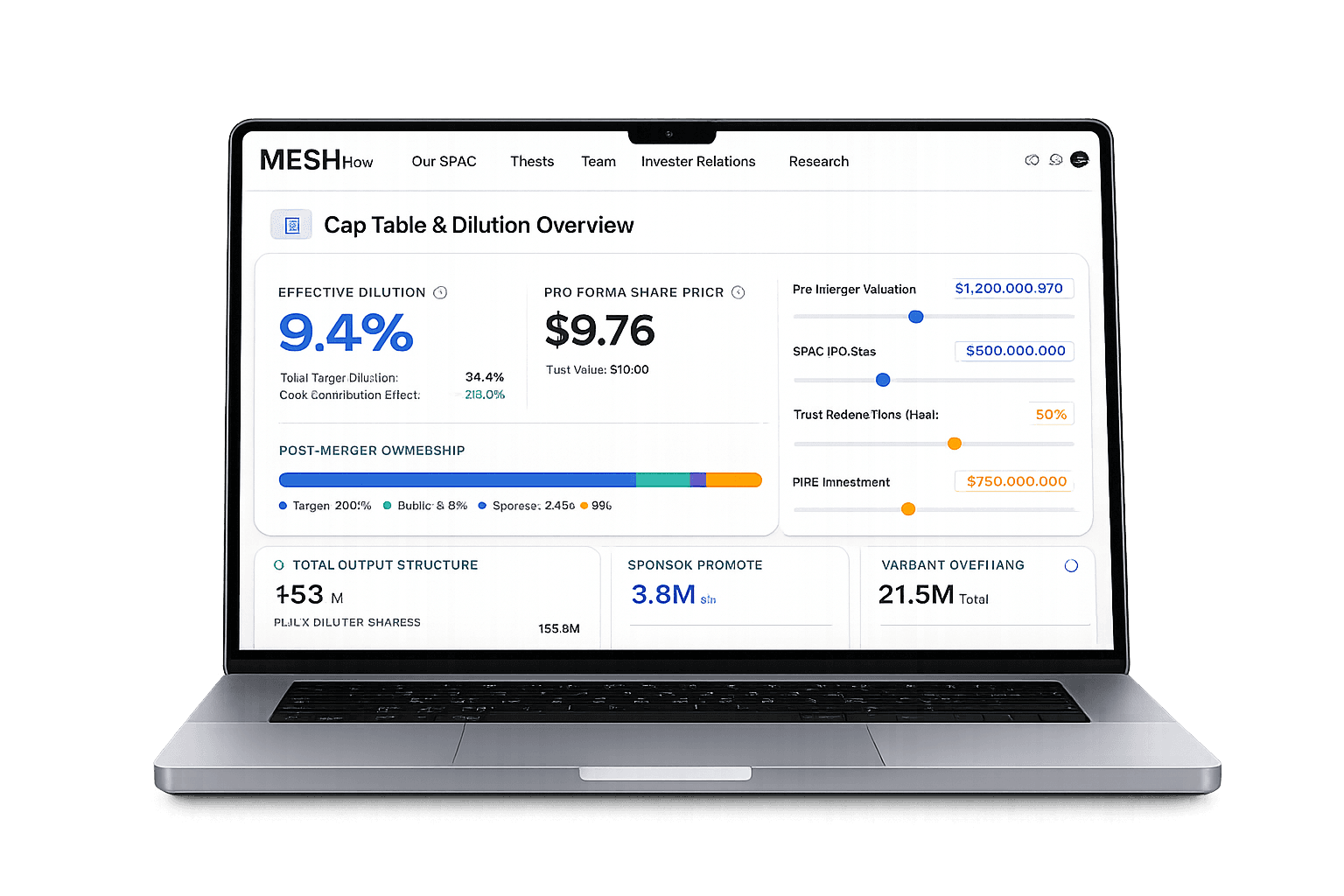
Explore Firms
Displaying 2106 structured records. Use the filters to narrow targeted search parameters.
| Ticker | Company | Status | Trust | Price | Warrant | IPO Date | Time Left | Deal Value | Sector | Bookrunner |
|---|---|---|---|---|---|---|---|---|---|---|
Unknown SPAC | announced | - | - | - | Sep 2003 | - | - | General | - | |
Unknown SPAC | announced | - | - | - | May 2003 | - | - | General | - | |
Unknown SPAC | searching | - | - | - | Dec 2000 | - | - | General | - | |
Unknown SPAC | searching | - | - | - | Feb 1997 | - | - | General | - | |
Unknown SPAC | announced | - | - | - | Aug 1996 | - | - | General | - | |
Unknown SPAC | searching | - | - | - | Jul 1996 | - | - | General | - |
What is a Special Purpose Acquisition Company (SPAC)?
A Special Purpose Acquisition Company (SPAC) is a publicly traded shell corporation engineered to raise capital through an Initial Public Offering (IPO) with the explicit purpose of acquiring or merging with an existing privately held operational entity. By leveraging a SPAC, private companies—especially within deep technology, fintech, and digital assets—can bypass the standard underwriter-led IPO roadshow, securing a more deterministic baseline for their institutional valuation.
Unlike legacy IPO setups, capital raised via a SPAC is strictly allocated to a secure trust account, typically held in short-term US Treasury Bills, until a definitive business combination is executed. Our advanced SPAC Tracker aggregates programmatic real-time data on these trusts, providing transparent insight into true warrant coverage overhang, liquidation windows, and implied deal velocities.
Why use an algorithmic SPAC database?
Evaluating a SPAC merger requires precise modeling of the capitalization table. Meshflow's authoritative database ensures institutional allocators and target CFOs have direct access to exact unit structures (e.g., fractional warrants), sponsor promote timelines, and trust proceeds. This data eliminates the opacity of front-loaded public market debuts, allowing for highly defensive transaction structuring.
Frequently Asked Questions
How does the SPAC Trust Account protect investors?
What is the impact of public warrant coverage?
How long does a SPAC have to find a target?
What is a Sponsor Promote?
Related Tools
Continue exploring other models and calculators.
Institutions Directory
Browse underwriters, legal counsel, and key financial institutions actively participating in SPAC transactions.
Dilution Calculator
Analyze the true cost of capital and implied dilution for your public market debut.
Developer MCP Setup
Connect your AI agents directly to Meshflow's proprietary data via the open-source Model Context Protocol.
Further Reading
Deep dives and research from our analysts.
The Hidden Costs of Traditional IPOs
A deep dive into the opaque structure of traditional underwriting fees and underpricing.
How SPAC Earnouts Align Founder Incentives
Understanding the mechanics of performance-based vesting and its impact on long-term shareholder value.
Understanding the Rule of 40 in Today’s Market
Why balancing growth and profitability is more critical than ever for public market readiness.